Little Island Surfboards
....since a long time ago.
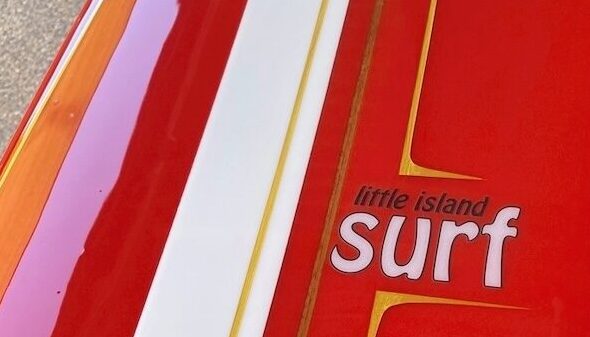
Bicheno became home in 1990 and Little Island Surfboards began.
Longboards were a speciality back then but times have changed and now it’s all things different.
Shapes and materials hold no bounds, UV initiated resins, epoxies, recyclable blanks, natural fibre cloths. Machines to shape, sand, polish, foil fins and more are the norm.
Some of us still do things the old way, after a lifetime of foam, fibreglass and dust it’s hard to change.
Shaping:
Shaping a surfboard is not an art, it’s part of the process. Most shapers are pretty good at what they do, some are better than others. The important thing is you give the customer what he/she wants. If it’s something special we can usually do it for you but if we can’t we don’t have a problem suggesting who can.
Surfblanks, made in Brookvale, Sydney are sold locally so they are the obvious choice for foam. Available in a multitude of lengths, strengths and densities they are the go to product for custom boards in Tasmania.
Laminating:
We like to use mainly “E” style fibreglass cloth. While there’s a myriad of different cloths today “E” has been around since the beginning. We know it lasts, has good strength to weight ratio, has reasonable UV stability and above all it’s the easiest to use. That means it wets out easily with most resins and lays down well, giving you a much stronger board.
There are some good Aussie resins but they are hard to find for the surf industry. Plenty of hybrids and additives can make it confusing but by far the best is Sylmar, imported from the USA, we use it when we can get it.
Fins:
Fins and fin systems are an external add-on for the manufacturer. There is so much competition in that field and the customer can choose these more to personal taste. We can install the boxes to whatever system is requested.
Finish:
Gloss and polish is the best looking finish but wet/dry on filler, wet/dry on gloss or flat acrylic spray seem to be the usual, your choice.
Epoxies:
In regard to epoxy resins and EPS blanks. While they have their place in the market they are more fragile, have a shorter life span, require different construction techniques, and they are harder to repair. We don’t use epoxy construction for those reasons.
Me:
Just passed 60 years in the surfboard industry.
They said the resin fumes and dust would kill us before we were 30 but that didn’t happen, go figure.
Worked in 23 different factories in Australia, Hawaii and California.
Can do every job in any one of them.
My forte is pin-lines and gloss-coats although I like laminating.
Shaping is a means to an end but after working with so many good shapers some of it sticks. I’m ok at it.
To last in this industry is difficult, hard work and attention to the basics is the key.
I’ve had more surfs than most and definitely had more fun, it’s been a ride.